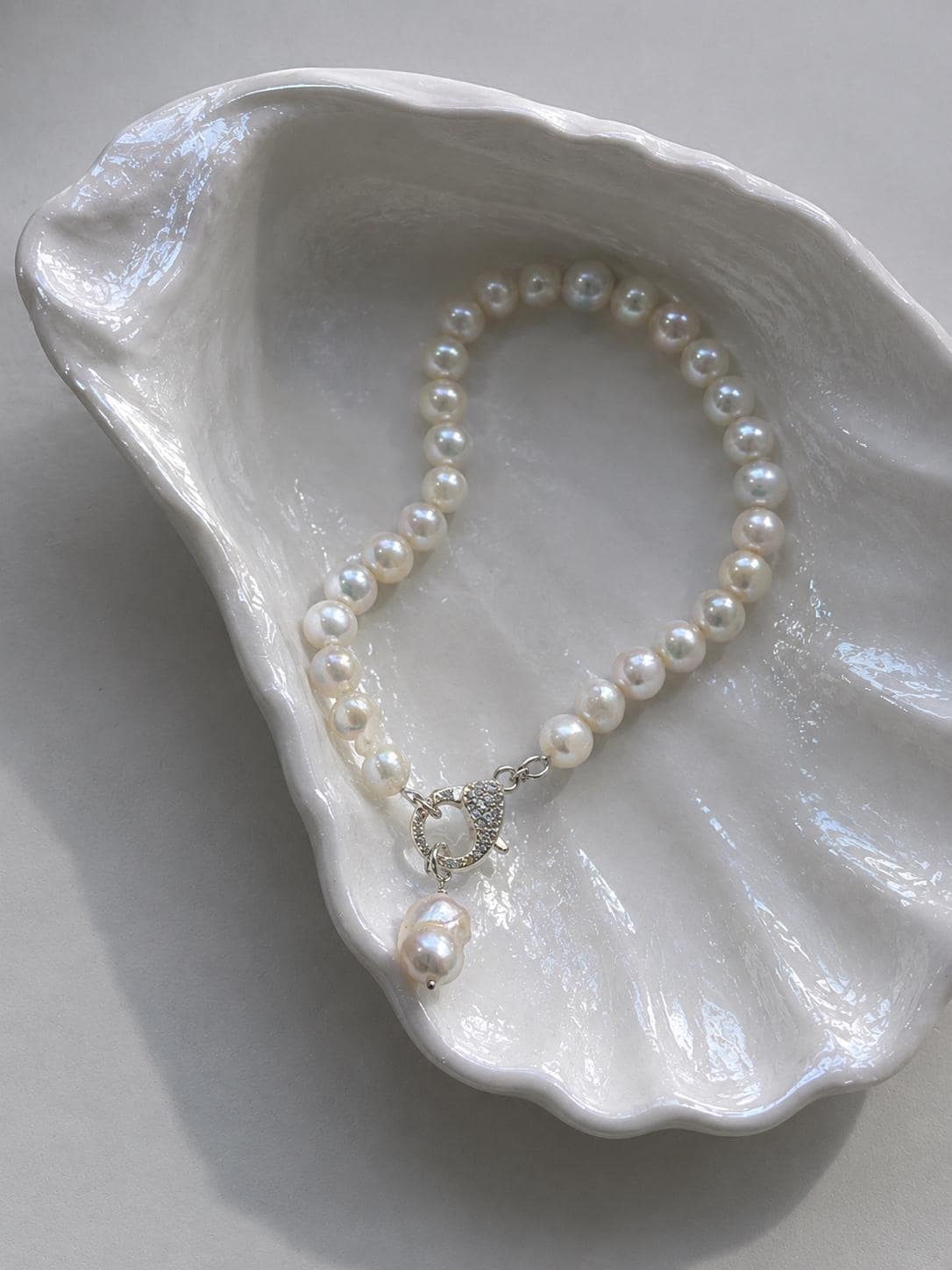
A round pearl has symmetry. A baroque pearl has a silhouette you remember: a soft curve, an unexpected ridge, a shape that seems almost sculptural. In a necklace or a pair of earrings, those details give the jewelry its personality.But baroque pearls are much older than contemporary jewelry styling. Their story connects the biology of living mollusks with the imagination of Renaissance goldsmiths—and explains why an irregular pearl can be so compelling.
What Are Baroque Pearls?
Baroque pearls are pearls with irregular, nonsymmetrical shapes. The word describes their form, rather than a particular species or place of origin. A baroque pearl can be freshwater or saltwater, natural or cultured. [1]Some look elongated or gently rippled; others have dramatic curves. “Semi-baroque” describes pearls with milder irregularities. Neither term automatically tells you the pearl’s quality or value.
Who Invented Baroque Pearls?
Nobody invented them. Irregular pearls develop inside living mollusks. People discovered them, named them, and learned to design jewelry around their shapes.It is helpful to separate two ideas: a pearl’s biological origin and its cultural history. Baroque pearls were not created by the European Baroque art movement. Their unusual forms already existed in nature, and jewelers were working with them during the Renaissance.
How Are Baroque Pearls Formed?
Natural pearls develop without deliberate human intervention. Cultured pearls begin with a farmer introducing tissue, a bead, or a combination of the two, depending on the cultivation method. The mollusk then produces the pearl through a biological process. Cultured pearls are real pearls. [2]For nacreous pearls, the mollusk deposits layers of nacre—the material also known as mother-of-pearl. When growth produces an irregular shape rather than a sphere, the result can be a baroque pearl. [1]Freshwater cultivation includes both tissue-only and bead-based methods; it is inaccurate to assume that every freshwater pearl has the same internal structure. GIA research documents cultivation methods yielding substantial numbers of baroque shapes. [3]The shape develops during growth. It is not normally carved into the pearl afterward to create a baroque outline.
How Are Baroque Pearls Harvested?
Pearls come from mollusks, rather than rock deposits. Before pearl cultivation became commercially established, people collected wild pearl-bearing mollusks; divers searched for them in marine waters. Finding a valuable natural pearl could require considerable effort. [4]Cultured pearls are grown in managed freshwater or marine environments. At harvest, the pearls are removed from their hosts. They are then cleaned, sorted, and graded before being selected for jewelry. [5]The word “baroque” does not specify a harvesting method. It describes the shape of the pearl that emerges from the process.
When Did Baroque Pearls Become Fashionable?
Renaissance Jewelry: Nature Becomes a Design
By the final quarter of the sixteenth century, enthusiasm for baroque pearls was growing, according to the British Museum. Goldsmiths used their unusual outlines as the starting point for imaginative settings. [6]A pearl could become the body of a sea creature, with gold and enamel supplying the surrounding details. One British Museum pendant depicts a hippocamp, a mythical sea creature, with a baroque pearl forming its body. [7]This is what makes the historical jewelry so fascinating: the designer responded to the pearl, rather than requiring the pearl to fit a standard shape.
The Twentieth Century: Cultivation Expands Access
Japanese pioneers developed successful whole cultured pearls around the beginning of the twentieth century. Cultured pearls became commercially important in the 1920s, and cultivation later expanded to more countries. [8]That history should not be mistaken for the invention of baroque pearls. Cultivation changed the supply of pearls; irregular pearls had already been used in jewelry for centuries.
Contemporary Jewelry: A Different Kind of Elegance
GIA identifies baroque pearls as particularly suited to artistic and contemporary designs. [1] Their visual appeal is easy to understand: a pearl with an unexpected outline can become the focal point of a simple necklace.For styling, pair a baroque pearl pendant with an open white shirt, or wear long pearl earrings with a clean neckline. A pearl-and-chain necklace offers another direction, combining soft luster with the sharper reflections of metal. For bridal styling, irregular pearls can add character to a restrained dress without requiring an elaborate jewelry set.These are styling suggestions, rather than evidence that baroque pearls became fashionable in one single recent year. Their appeal has been revisited across different periods and designs.
Are Baroque Pearls Valuable?
Shape alone does not determine value. GIA evaluates pearls using seven factors: size, shape, color, luster, surface, nacre, and matching. When other qualities are equal, round pearls generally command higher values, but an appealing baroque pearl can still make a beautiful piece of jewelry. [1]When choosing one, consider the brightness of its reflections, its surface condition, and whether its outline suits the design. An organic shape is part of its character; it should not be used to dismiss every surface problem as desirable.
Frequently Asked Questions
Are baroque pearls real pearls?
Genuine baroque pearls can be natural or cultured. “Baroque” describes shape, so the label alone does not authenticate an item. Ask the seller to identify the pearl material and origin. [1, 2]
Are all baroque pearls freshwater pearls?
No. Irregular shapes occur in freshwater and saltwater pearls. Freshwater is a pearl category; baroque is a shape description. [1]
Were baroque pearls invented during the Baroque period?
No. They form biologically, and their use in Renaissance jewelry predates the seventeenth-century Baroque style. [6, 7]
Why choose a baroque pearl necklace?
Choose one if you enjoy organic shapes and a focal point with its own character. A simple setting gives the pearl’s outline room to stand out.
Discover Your Own Pearl Silhouette
Explore YAJEWELRY pearl necklaces and find the shape that speaks to your style—from a subtle organic accent to a sculptural statement.